The Operating Model Behind Top-Producing Real Estate Teams
October 6, 2026
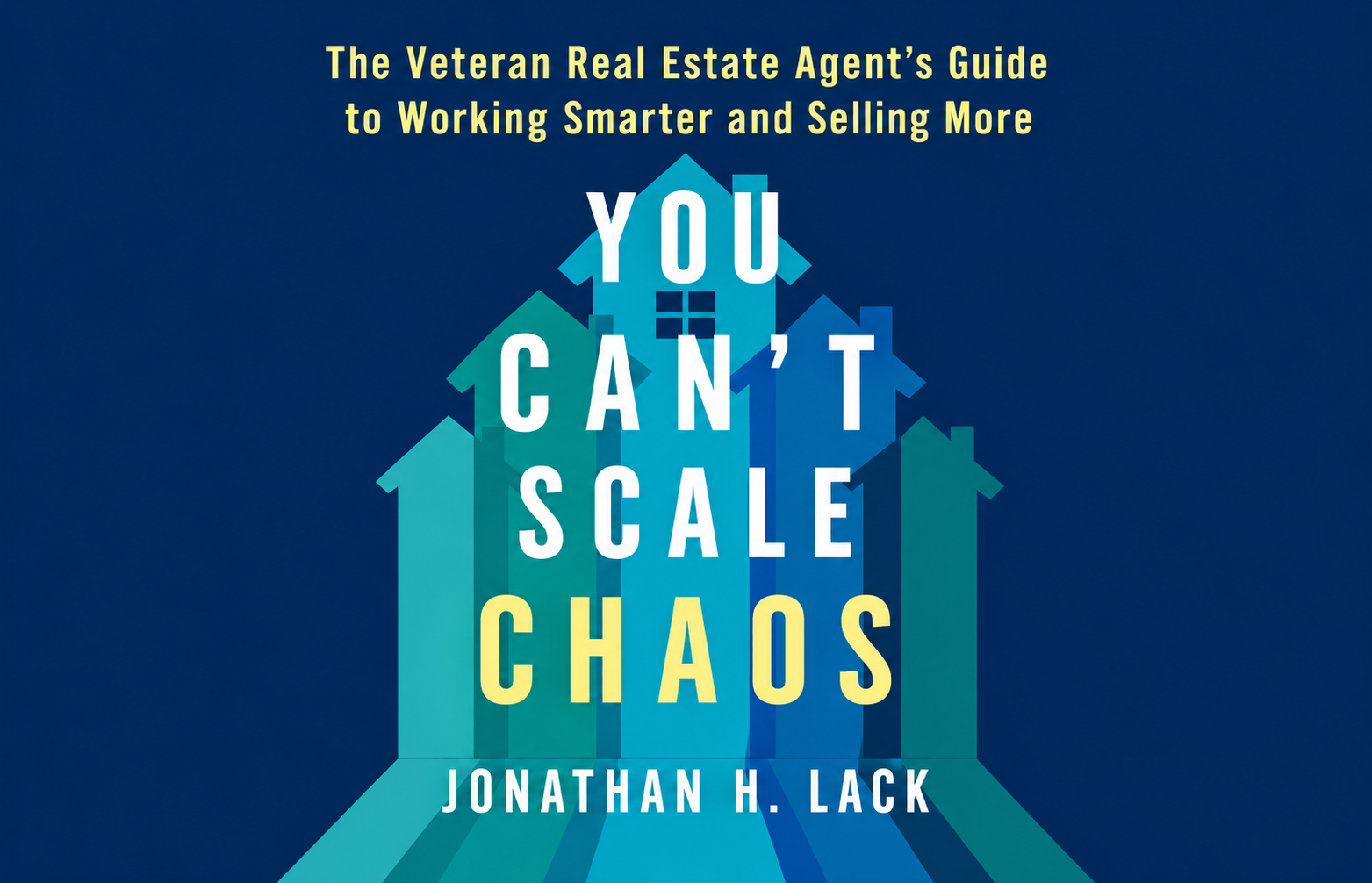
Source: You Can't Scale Chaos
At a Glance
If you're a top-producing agent who feels like you've hit a ceiling, I can tell you it's probably not your talent and it's not your work ethic. It's chaos. Your production has grown, but the business behind it hasn't. And you can't scale chaos.
The answer isn't working harder. You've already maxed out that card. It isn't some new piece of technology either. It's the simple business fundamentals most agents were never taught: client focus, process, and metrics. In this white paper, I'll explain why chaos holds you back, what a real operating model for a real estate team looks like, and how my SELL framework (Strategy, Execution, Leverage, and Leadership) gives you a roadmap to get there. Everything here comes from my book You Can't Scale Chaos and from my work with top agents and teams across the country.
Who this is for: experienced agents and team leaders with roughly 100 or more transactions over the last ten years who want to keep growing without adding hours to a week that's already full.
Why do successful real estate agents hit a growth ceiling?
Here's the short answer: everything depends on you. You're already working sixty-plus hours a week, and there's simply no room left to do more of what got you here. The moment you slow down, the business slows down too.
I've consulted for top agents all over the United States, and I see the same pattern over and over, regardless of market or team size. You're constantly putting out fires and reinventing the wheel. There's a lot of activity and a lot of stress, but very little planning or predictability. You rarely step back to look at the big picture, and that client data you sweated to collect? It's sitting there, unused.
I think of it as a leaky boat. You built your business from scratch and you've been paddling from deal to deal for years, bailing water along the way. Early on, that's manageable. But the faster you grow, the more water you take on, until growth itself becomes exhausting.
It's not your fault. Agents are trained to sell and write contracts. Nobody teaches you how to build and run a business.
Why a hot market hides the problem
Real estate lets you get away without business discipline longer than most industries. Your capital requirements are low, your fixed costs are modest, and you don't have loans to pay off or investors to answer to. In a hot market, you can do pretty well without worrying about best practices.
But hot markets never last forever. Plenty of agents had record years during the pandemic, and then rates went up in late 2022 and demand took a nosedive. Many of those same agents took huge hits. Cutting costs helped them survive, and sometimes that's necessary. But cutting costs is not a strategic plan. It won't help you grow. The agents who came out strongest were the ones who used the tough times to plug the holes in their boats.
Why chaos cannot scale
You can't perfect chaos, and you can't repeat it. It doesn't get more efficient as it grows. It only drives you crazier and drags you down faster.
So what's the opposite of chaos? Most people would say order. In my world, it's strategy. Strategy is order with intention, reason, and purpose. It means aligning every part of your business around a long-term vision that serves your clients, your team, your community, and most of all, you.
What drives most real estate businesses today?
By default, most agents run their business through three lenses: transactions, personality, and creativity. There's nothing inherently wrong with any of them. But on their own, none of them is a competitive advantage over the long run.
Transactions. You may be great at buying and selling homes, but so are thousands of other agents in your area. And technology has made it easier than ever for buyers and sellers to get through a deal with minimal professional help. A steady stream of one-time transactions with new clients just isn't a sustainable model anymore. Long-term growth comes from repeat and referral business, from maximizing the lifetime value of every client.
Personality. Your personality has probably been a big part of how you win clients and close deals. But when personality runs the show, you do things how you want, when you want, and you manage your team based on how you're feeling that day. You end up spending too much time on things that feel good but don't produce results, and too little on the important things you don't enjoy.
Creativity. Creativity is great for solving problems. But not every idea is worth pursuing. Maybe you have twenty ideas about how to market your business and no clue which ones will actually work. So you try them all, spread yourself too thin, and change lanes too often to make real progress. Unrestrained creativity can do real damage to your growth.
What are the three missing drivers of a scalable real estate business?
Running a business on transactions, personality, and creativity might have worked twenty years ago. Not anymore. To fully leverage what you've built, you need to add three more drivers: client focus, process, and metrics.
Client focus means the client experience is your top priority, not just during the transaction but before and after it. Your clients' interests come first, even above your own. Everything you do is designed to build their trust, so they come back to you for every real estate need and send their friends your way.
Process means you have a defined way of doing things in every part of your business. That's how you minimize mistakes and get a little better every time. It's also what lets you delegate, so other people can handle the day-to-day and you can spend your time on what only you can do.
Metrics means you use data about your business and your market to make decisions instead of going by gut feel. Track the key numbers and you'll improve your performance, manage your risk, and stay focused on your goals. It also keeps you levelheaded when the market gets emotional.
Here's what it looks like when all six drivers work together:
| Default driver | Paired with | What it looks like in practice |
|---|---|---|
| Transactions | Client focus | Strong deal execution plus relationships that produce steady repeat and referral business |
| Personality | Process | The agent's personality drives the brand, while processes drive daily operations, even on days the agent does not feel like following them |
| Creativity | Metrics | Ideas are generated freely, then tested against data before resources are committed |
What is a rainmaker team?
You cannot maximize your potential all by yourself. You need a team that takes the low-value work off your plate, so you can focus on the high-value work of building relationships and serving as your clients' trusted advisor. I call this the rainmaker team.
Think about professional tennis. Today, every top player has a support team: a coach, a fitness trainer, a practice partner, maybe a nutritionist or a sports psychologist. That wasn't common until a couple of decades ago, when Federer, Nadal, Djokovic, and Serena and Venus Williams came on the scene. With their teams behind them, they reached levels of performance and longevity that earlier generations never dreamed of.
The same thing is happening in real estate. Solo agents can't keep up with the demands of the job, and large teams are very hard to manage. For most veteran agents, a high-functioning rainmaker team is the sweet spot and the best path to further growth.
Who is on the team
You already have a team, even if you don't think of it that way. It's anyone who supports your business goals, full time, part time, or temporary:
- Team members in clearly defined roles, like a buyer associate, listing manager, and transaction coordinator
- Consultants for marketing, bookkeeping, and operations
- Vendors like stagers, photographers, contractors, and your title partners
These people add value to your business the same way you add value to your clients' transactions. In the next paper in this series, I'll walk through how to define those roles so nobody is left guessing.
How does the SELL framework turn chaos into strategy?
I built the SELL framework to keep the fundamentals simple and easy to remember: Strategy, Execution, Leverage, and Leadership. Each stage builds on the one before it.
| Stage | The question it answers | What the team builds |
|---|---|---|
| Strategy | Where are we really, and where should we focus? | A full audit of sales, competitors, finances, brand, and market trends, leading to clear rules about which business to pursue |
| Execution | Are the daily basics done right, every time? | Defined roles, process checklists, communication protocols, and a time-blocked calendar |
| Leverage | How do we get more from every effort? | The right tools (CRM, project management, document management, accounting), a consistent marketing plan, disciplined business development, and monthly metrics |
| Leadership | Who keeps it all on track? | Accountability for the leader and the team, compensation tied to performance, quarterly team reviews, and a succession plan |
I'll be honest: none of this is flashy or sexy. There's no magic here, just clean, simple business fundamentals, the same ones I've used for thirty years to help companies grow and become more profitable. And it won't happen overnight. Implementing these fundamentals takes at least a year, often two or three, and honing them never really stops. You don't have to tackle them in strict order. But to reach the full potential of your business, you'll eventually need all four.
Case study: from solo agent to rainmaker team
My first real estate client was Carey Hagglund Condy. When she started doing what I teach, she more than doubled the volume she could handle without increasing her workload.
Carey had been in the business sixteen years and was one of the top solo agents in Marin County, a highly competitive market just north of San Francisco. Her business was a success, but it was also chaotic. She was doing absolutely everything herself, she never had time to plan ahead, and she judged how the business was doing by intuition alone. She was on a fast track to burnout, and she knew the moment she slowed down, everything would slow down with her.
I agreed to work with her on the same condition I give every client: I'd tell her what she needed to hear, not what she wanted to hear. After a thorough audit, I could see she had the potential to double her sales in two to three years without working any harder than she already was. We fixed the leaks, built the systems, and put a small but professional support team in place.
| Measure | Best year before | 2022 |
|---|---|---|
| Units sold | 18 | 42 |
| Sales volume | $64 million | $175 million |
Even in 2023, a down year with high interest rates, she outperformed her market and was on track for more than $100 million. More importantly, she has time to breathe now. When she's out sick or on vacation, her team keeps things moving without her. And we're already planning her exit, so she can step back gradually and keep getting value from the relationships she spent decades building.
Where should a team leader start?
Start by asking yourself some honest questions. If more than two or three of these statements describe your business, chaos is costing you growth.
- I cannot pull a complete list of my past transactions in under an hour
- I do not know what I actually net on an average transaction
- My team members' responsibilities are not written down
- Important information lives in scattered text threads and inboxes
- My marketing changes month to month based on cash flow or mood
- Business development slips whenever I get busy with active deals
- I review my numbers only at year end or tax time
- The business stalls when I take a vacation
- I do not have a plan for how I will eventually step back
Here's where I start with every client: the sales audit. If I asked you to show me every transaction from your entire career, could you do it? Most agents would have to go digging through spreadsheets, PDFs, and paper files. Get it all in one place, then look at which neighborhoods, price points, and client sources actually produce your business. My clients never fail to find something in their data that surprises them, and it changes how they invest their time and money from that point on.
Frequently asked questions
What does "you can't scale chaos" mean in real estate?
It means a business that runs on constant improvisation cannot grow efficiently. Each new transaction adds the same stress and friction as the last, so growth only increases the workload.
What is a real estate operating model?
It is the combination of strategy, team structure, workflows, financial reporting, and accountability that sits behind an agent's production and determines how much business the team can handle.
What is the SELL framework?
SELL stands for Strategy, Execution, Leverage, and Leadership. It is a four-stage roadmap from You Can't Scale Chaos for turning a chaotic real estate practice into a strategically run business.
How long does it take to implement?
Most teams need one to three years to fully implement the framework, with continuous improvement after that.
Is this only for large teams?
No. It is designed for experienced agents and small rainmaker teams, though the principles apply to larger teams as well.
About the author
Jonathan H. Lack is the principal of ROI Ventures, host of the ROI BizTalk podcast, and author of You Can't Scale Chaos. He holds an MBA from the Wharton School and a master's in international relations from Johns Hopkins SAIS, and has spent more than thirty years in strategic planning and operations management. He helps top residential agents and team leaders build more manageable, profitable, and sustainable businesses as a strategic advisor and fractional COO.
Next step
If you want to work smarter and sell more, I'd love to help. Let's talk about where chaos is costing your business, or learn more about how I work with teams as a fractional COO.
Next in this series (November 3): Beyond "The Assistant": Designing Roles, Responsibilities, and Checklists for a Rainmaker Team.